A spa is a business that offers care and relaxation services such as massage, hammam, sauna, steam room, skin care and a pool under one roof. It may be inside a hotel, in a city centre or right at a thermal spring. The word comes from the name of Spa, a town in Belgium known for its mineral waters.
The main types you will come across in Turkey are the day spa, the hotel and urban spa, the resort spa, the thermal spa and hot spring, the medical spa and the hammam. Below we explain what you will find at each, how a spa visit works and how the price is made up.
What does spa mean, and where does the word come from?
Spa is the name of a town in eastern Belgium whose mineral springs have been known since the 14th century. The town's name goes back to the Walloon word espa, meaning "spring, fountain". The word has been used in English since the 1620s. One of the Cambridge Dictionary's definitions is still this: a spring town where people go to drink or bathe in the water because they believe it is good for their health. The sense of a commercial business offering health and beauty treatments was in use by 1960.
The Global Wellness Institute, known for its industry research, defines spas as businesses that support healthy living through professional treatment services, and classifies their types separately. In this classification the Turkish bath appears, together with Ayurveda centres in India, among the spa facilities rooted in cultural tradition.
What does SPA stand for?
The most commonly given expansion of spa is the Latin salus per aquam or sanitas per aquam, meaning "health through water". There is no historical basis for this explanation: it does not appear in written sources before the 21st century, and it does not match the town's name in Roman times either. Etymological dictionaries trace the word to the town's name; the Latin expansion was most likely made up later.
What types of spa are there?
The types are distinguished by where the spa is and what people go there for:
| Type | Where you find it | Typical services | Who it suits |
|---|---|---|---|
| Day spa | In town, with no accommodation; sometimes inside a gym or beauty salon | Massage, skin and body treatments, short packages | People who want to go and come back the same day |
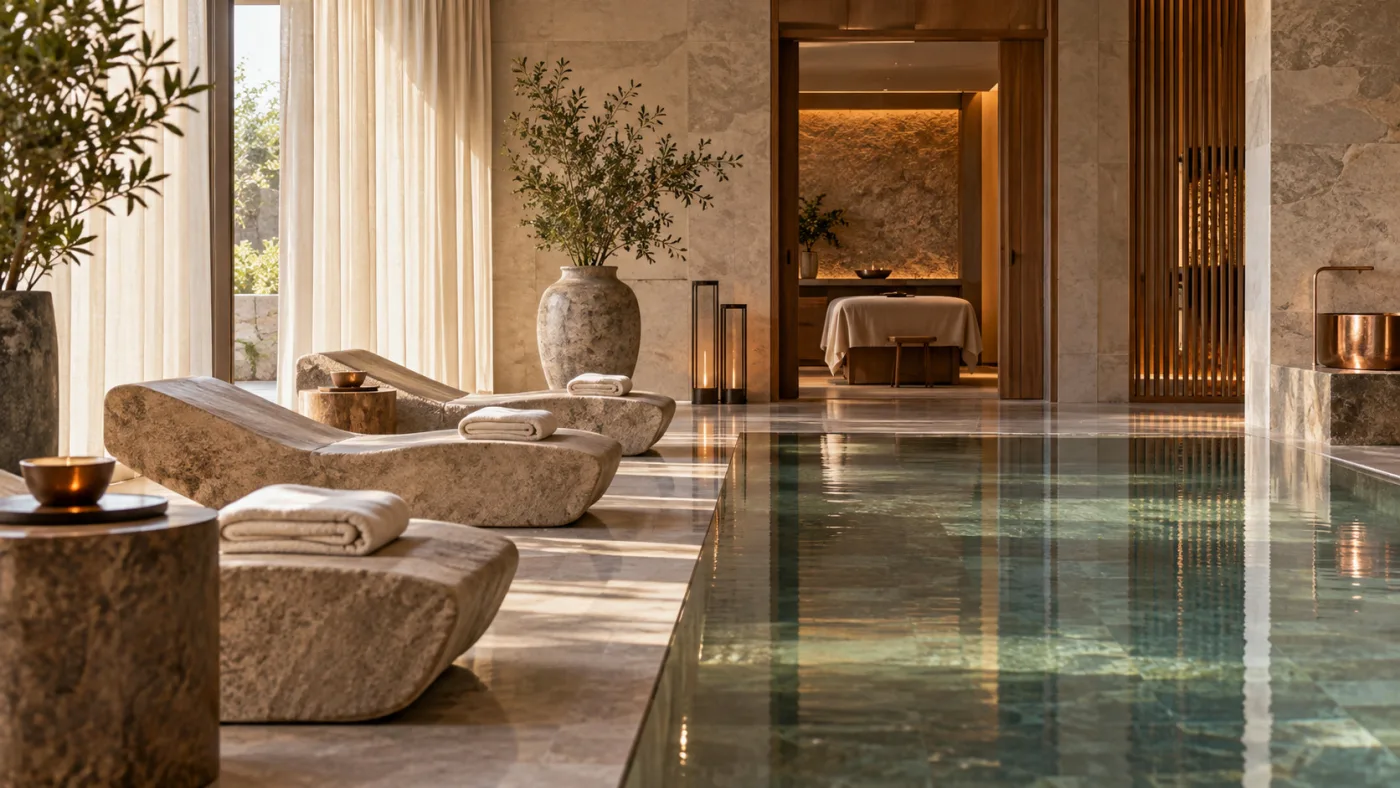
| Hotel spa and urban spa | In city hotels or in the city centre | Massage, hammam, sauna, steam room, sometimes an indoor pool and gym | Hotel guests; people setting aside a few hours after work or at the weekend |
| Resort spa | In holiday resorts, beach hotels and countryside hotels | Massage and treatment menu, pools, hammam, sauna | People combining their holiday with the spa |
| Destination spa | Wellness retreats offering stays built around a programme | Exercise, nutrition advice and wellness programmes on top of spa treatments | People who want to join a programme lasting several days |
| Thermal spa and hot spring | Where there is a thermal spring; in thermal hotels | Thermal pool, courses of baths, mud (peloid) treatments, massage | People who want to relax in thermal water or follow a cure under a doctor's supervision |
| Medical spa | Facilities operating under the supervision of a health professional | Medical or cosmetic procedures alongside spa services | People looking for treatments under medical supervision |
| Hammam | In historic buildings, in residential neighbourhoods, in hotel spas | Sweating in the hot room, kese (exfoliating scrub), foam wash, often a massage | People who want the traditional ritual |
Day spa
No overnight stay is needed: you book an appointment, have your treatment and leave the same day. The Global Wellness Institute defines this group as spas offering services such as massage and skin care on a day-use basis. Spas operating inside a gym or beauty salon also fall into this group. You can browse the day spas in our directory here.
Hotel spa and urban spa
Hotel spas are inside the hotel, but they are not necessarily open only to people staying there. The Global Wellness Institute defines them as facilities serving both hotel guests and people who live in the city. If you are going as an outside guest, ask in advance whether you can use the spa area on its own or whether you need to book a massage or package. In our directory these are listed under hotel spa.
Spas in the city centre that people visit for a short massage or treatment are grouped in our directory under urban spa. If you want an hour's massage at lunchtime or after work, you can start your search here.
Resort spa and destination spa
A resort spa is part of a holiday resort or beach hotel; the spa is one of the services within the holiday. You can filter the resort spas in our directory by city and service.
At a destination spa, the place itself is the point. According to the Global Wellness Institute, these facilities offer a programme that takes up the guest's whole day, combining spa treatments with exercise, nutrition advice and other wellness practices. In short, at a resort the spa is part of the holiday; at a destination spa the programme is the holiday.
Thermal spa and hot spring
Under the Ministry of Health's Regulation on Hot Springs, thermal water is water whose temperature at the point where it emerges is 20 °C or above. A hot spring facility is one where natural thermal or thermomineral water is made available to the public. The regulation distinguishes between two uses of thermal water: treatment applied as a cure, and the use of the water for tourism and relaxation rather than treatment. It calls the second "recreation".
Hot spring facilities offering treatment must obtain a permit from the provincial governor's office and employ a specialist doctor and full-time health staff. If you are going to relax in a thermal pool, that is what the regulation calls recreation. If you want a cure under a doctor's supervision, ask whether the facility is a licensed hot spring facility and whether a doctor is present. You can find the thermal spas in our directory here.
Medical spa
The Global Wellness Institute defines a medical spa as a facility that operates under the supervision of a licensed health professional and combines spa services with medical or cosmetic procedures. A place calling itself "medical" does not mean that this supervision exists. If anything other than massage and treatments is on offer, ask before booking who will carry out the procedure and whether there is a doctor on site.
What is a spa day, and what does "spa" mean at a hotel?
What is a spa day?
A spa day means spending a whole or half day at a spa without staying overnight. Venues usually sell it as a package: use of the wet area (hammam, sauna, steam room, pool), a massage or treatment and often a light refreshment are included in one price. In Turkish it is also called a günübirlik spa paketi (day spa package).
What does "spa" mean at a hotel?
When a hotel's description mentions a "spa", it means the hotel has a spa area that guests can use. This usually includes a hammam, sauna, steam room, indoor pool and massage rooms. At most hotels, use of the wet area is included in your stay; massages and treatments are charged separately. Some city hotels also open their spa to outside guests with a day pass.
What is the difference between a hammam and a spa?
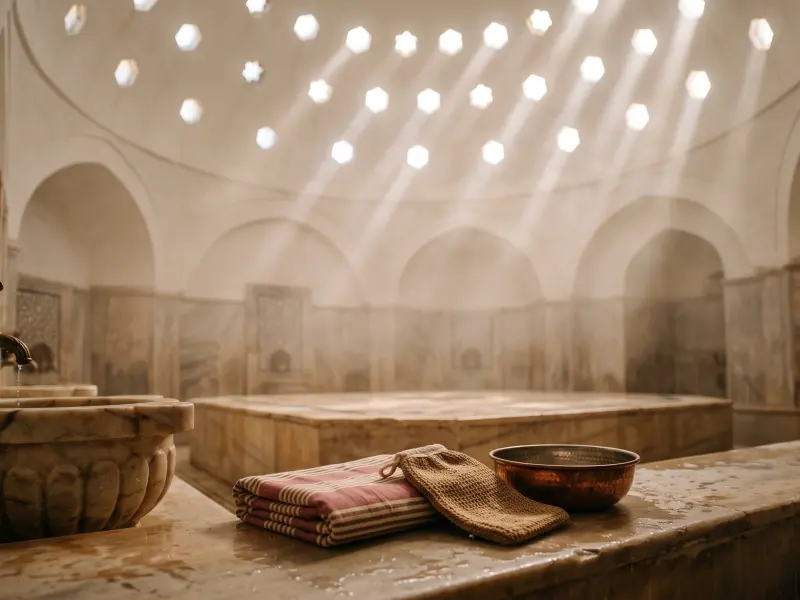
A hammam is a ritual; a spa is a place where services are brought together. In a hammam you warm up in the hot room, sweat on the navel stone (the heated marble platform), then have a kese and foam wash; an attendant (tellak or natır) usually looks after you throughout. A spa offers services such as massage, skin care, sauna and a pool separately, and a hammam may be one of them.
The heat differs too. According to Harvard Health, the dry air of a sauna can reach 85 °C. In a hammam and a steam room the temperature is lower, but the humidity is much higher. You can read our article hammam or sauna?, which compares the three by temperature, humidity and time, and browse the hammams in our directory here.
What do you do at a spa?
Spa menus vary from place to place, but most include some of the following services:
- Massage. The core of the spa menu. Swedish, deep tissue, aromatherapy, hot stone, Balinese and Thai massage differ in length, pressure and technique. We explain which one suits you in our guide to massage types.
- Hammam, kese and foam wash. If the spa has a hammam, the kese and foam wash is either sold as a separate service or included in a package.
- Sauna and steam room. One is a dry heat room, the other a humid one. Harvard Health's advice is as follows: do not stay in the sauna for more than 15-20 minutes, avoid alcohol before and after, cool down gradually when you come out and drink two to four glasses of cool water. Do not use a sauna when you are ill. People with uncontrolled high blood pressure or heart disease should consult their doctor first.
- Skin and body treatments. Treatments such as facials, body scrubs and body masks.
- Pool and jacuzzi. An indoor pool and jacuzzi; at thermal resorts, a thermal pool.
- Relaxation area and fitness. Some spas have a relaxation room where you can sit between treatments, and a gym.
How does a spa visit work?
Booking
Book an appointment for services that need a therapist, such as massages and treatments. When booking, ask: how many minutes is the actual treatment, how long can you use the shared areas such as the pool, sauna and hammam, and what is the cancellation policy? Arrive a little before your appointment time to change and shower.
What do you wear?
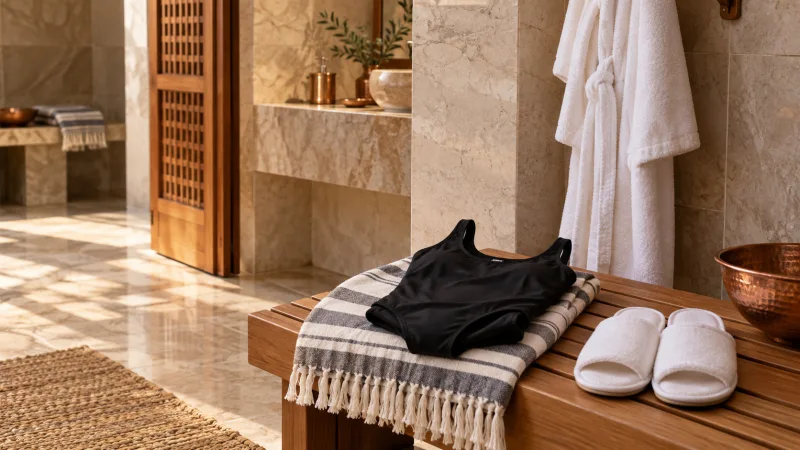
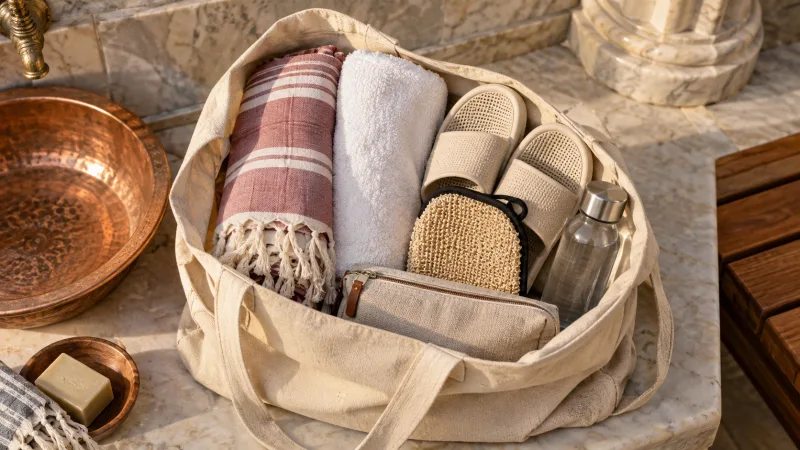
In the pool and jacuzzi you wear a swimsuit or bikini. What to wear for a massage and in the hammam, the rules on covering up and privacy all vary from place to place; you will find the details in our article what to wear at a hammam and spa. When booking, ask whether a towel, robe and slippers are provided.
How long does it take?
The length of each service is shown on the menu, and it is what affects the price most directly. When you combine services the time quickly adds up: add a 30-minute kese and foam wash to a 50-minute massage and the treatments alone take 80 minutes. Add extra time for changing, showering and resting afterwards, and leave a margin if you have somewhere to be afterwards.
How is the price set?
Spas usually price their services in three ways:
- Day pass (use of facilities). The right to use shared areas such as the pool, sauna, steam room and hammam for a set time. What is included varies by venue; ask separately whether services that need a therapist, such as massage and kese, are included.
- Single service. One massage or treatment. The price depends on the length and type. Find out whether you can also use the shared areas when you book it.
- Package. A combination of several services. For example, on Divan İstanbul's spa page, a package combining a 50-minute Swedish massage with a 30-minute kese and foam wash, including use of the pool, sauna and hammam, is sold online at a discounted price of 7,400 TL (23 September 2026). The same hotel also offers 10-session packages for massage and skin care, to be used within 6 months. You can see the venues offering spa packages together in our directory.
When comparing two offers, look at what is included rather than the total price: the actual treatment time, use of the shared areas, whether a towel and robe are included, and any difference between weekday and weekend prices.
How to choose the right spa for you
Start with what you need:
- You have an hour and only want a massage: an urban spa or a day spa.
- You want to spend half a day with a pool, sauna and hammam: a hotel spa with shared facilities. Ask whether it accepts outside guests.
- You are planning a holiday: a resort spa. Find out in advance whether spa services are included in your stay.
- You want thermal water: a thermal resort. If it is for treatment, ask about its permit and whether a doctor is present.
- You want the traditional ritual: a hammam.
Whichever type you choose, look at the hygiene arrangements, the therapists' training, how use by women and men is arranged, and the cancellation policy. If you are pregnant or have a chronic condition, consult your doctor before using a sauna or hammam or having a massage.
On Spa Deneyimi, every venue's profile shows its list of services, opening hours and contact details. Rankings cannot be bought.
Sources
- Etymonline: spa
- Wikipedia: Spa (etymology section)
- The Spa Manager's Essential Guide, chapter 8: Spa definitions, history, facility types (Goodfellow Publishers)
- Global Wellness Institute: Spa Industry
- Ministry of Health Regulation on Hot Springs (mevzuat.gov.tr)
- Harvard Health: Saunas and your health
- Divan İstanbul spa packages
This article was written by the Spa Deneyimi editors. Rankings and verification badges cannot be bought.