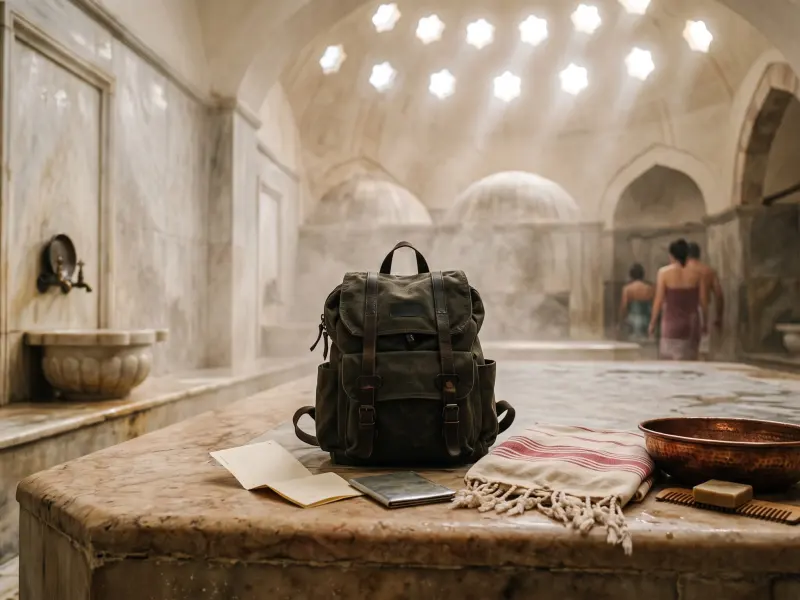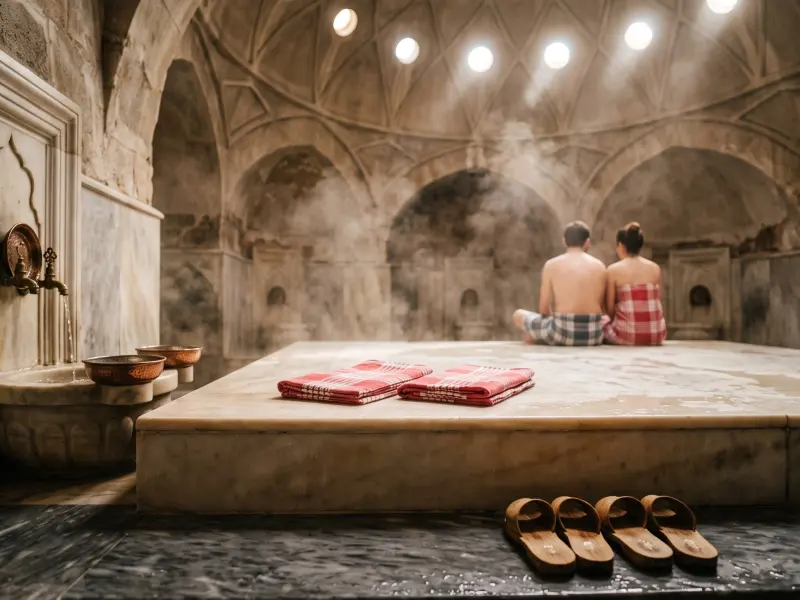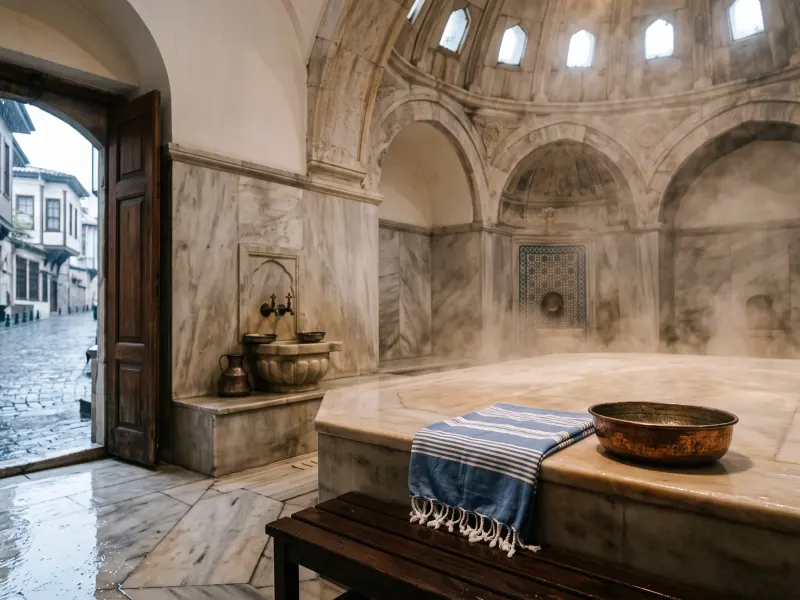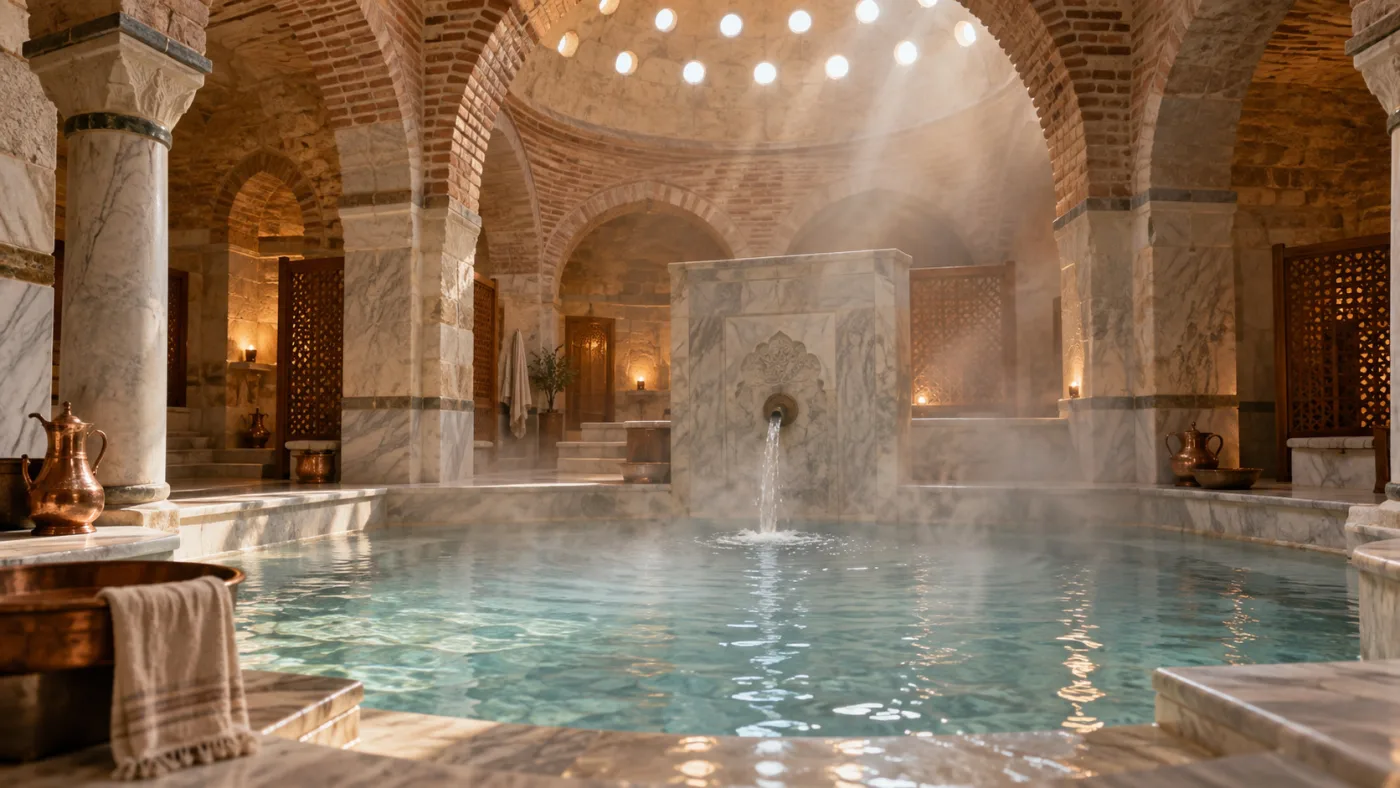
Most of Bursa's historic hammams and hot springs that still operate today are clustered in Osmangazi, in the Çekirge and Kükürtlü neighbourhoods, on the slope where natural hot water rises to the surface. Most of these buildings are in fact hot springs: the water is not heated in a boiler but arrives hot from the source. The oldest go back to the 14th century, to the reign of Murad I. The best known is Yeni Kaplıca ("New Hot Spring"), commissioned by Rüstem Paşa in 1552. Below you will find seven buildings with their districts, construction periods and arrangements for women and men. For those that publish prices, we have added those too.
Bursa's historic hammams and hot springs at a glance
| Hammam | District | Type | Built | Women/men arrangement |
|---|---|---|---|---|
| Eski Kaplıca | Çekirge (Kükürtlü) | Hot spring | Reign of Murad I (14th century), repaired in 1511 | Separate women's and men's sections, family hammam |
| Çekirge Hamamı (Adak Hamamı) | Çekirge | Hot spring | 1365-1370 | Known as a women's hammam |
| Keçeli Hamamı | Çekirge | Hot spring | 14th century | Women's hammam |
| Kara Mustafa Kaplıcası | Kükürtlü (Bademlibahçe) | Hot spring | Given as 1490 | Public hammam and family baths |
| Yeni Kaplıca | Kükürtlü | Hot spring | 1552, Rüstem Paşa | Men's section and family baths |
| Kaynarca Kaplıcası | Kükürtlü | Hot spring | Late 17th century | Women's section |
| Çakır Ağa Hamamı | Osmangazi (foot of the citadel) | Hammam | Reign of Murad II (15th century) | Double hammam: women and men separate |
The difference between a hot spring and a hammam
According to the TDV İslâm Ansiklopedisi (the TDV Encyclopaedia of Islam), a hot spring also differs from a hammam in its plan. In a hammam, the navel stone (the heated marble platform) sits in the middle of the hot room. In a hot spring its place is taken by a pool, reached down a few steps and almost as deep as a person is tall. No külhan (furnace) is needed to heat the water; the water comes hot from the source and is cooled to a comfortable warmth in the basins and the pool. The changing room and the warm room, however, keep the layout of the classic Turkish bath. The encyclopaedia notes that the most typical examples of Ottoman hot-spring architecture in Anatolia are in Bursa.
The hot springs and hammams one by one
Eski Kaplıca (Çekirge)
Eski Kaplıca ("Old Hot Spring") is considered the oldest and most important of the Çekirge hot springs; it is also known as Armutlu Hamamı. Bursa Metropolitan Municipality writes that the building was founded in the reign of Murad I on the remains of an old Byzantine bath. According to the TDV İslâm Ansiklopedisi, a great deal of reused material went into its construction. The inscription over the main door records the repair of 1511 and that the changing room was added at that time. In the middle of the hot room there is a round pool 7 metres across, and the women's section is in a small building adjoining the warm room.
Today it operates as part of the Kervansaray Termal Hotel. According to the hotel's website, the latest restoration was completed in August 2013, and a family hammam was added alongside the women's and men's hammams. The thermal section is open daily from 07:00 to 22:00, and the water is 44 °C. Ask the hotel about the conditions and price for guests from outside the hotel.
Çekirge Hamamı (Adak Hamamı)
According to the Ministry of Culture and Tourism's Kültür Portalı (Culture Portal), it was built between 1365 and 1370. It stands on I. Murad Caddesi, in front of the Askeri Hastane (Military Hospital), below street level; you go down a few steps to the door. It is a hammam built for bathing free of charge, which women regarded as healing and sacred. That is why it is also known as Çekirge Sultan Adak Hamamı or Kadın Hamamı (the Women's Hammam). Above the entrance you can see a sea-wave motif worked in brick. Its current opening hours and price are not published; check that it is open before you go.
Keçeli Hamamı (Çekirge)
It stands on the corner where I. Murad Caddesi meets Selvi Sokak. The Kültür Portalı says the building was put up before the reign of Mehmed the Conqueror (Fatih), while Bursa Metropolitan Municipality writes that it was built in the 14th century to be fed by the Vakıfbahçe thermal spring. The TDV İslâm Ansiklopedisi counts it among the Çekirge hot springs: in the middle of the domed hot room there is a round pool, with three basins around it. Today it serves women as part of the Marigold Thermal & Spa Hotel, under the name Tarihi Keçeli Kadınlar Hamamı (Historic Keçeli Women's Hammam). Address and contact details are on the Keçeli Tarihi Kadınlar Hamamı profile.
Yeni Kaplıca, Kaynarca and Kara Mustafa (Kükürtlü)
All three are on Yeni Kaplıca Caddesi, under the same management. They share an address, a phone number and a price list.
Yeni Kaplıca. According to the operator's website, it was built in 1552 by the grand vizier Rüstem Paşa, on the orders of Sultan Süleyman the Magnificent, so that the sultan could recover his health. The TDV İslâm Ansiklopedisi regards it as one of the more developed examples of Ottoman bath architecture. The cooling room is covered by two large domes 12 metres in diameter. In the middle of the hot room, which is shaped like an eight-pointed star, there is a large pool. The hot water flows from a stone spout shaped like a lion's mouth first into a small pool and from there into the large pool; the walls are covered in tiles. Today it operates with a men's hammam and family baths. Details are on the Yeni Kaplıca Erkekler Hamamı profile.
Kaynarca Kaplıcası. Next to Yeni Kaplıca, it was built in the late 17th century. Today it operates with a women-only hammam and a thermal hotel; kese (exfoliating scrub) and massage are offered in the women's section.
Kara Mustafa Kaplıcası. The TDV İslâm Ansiklopedisi says it is not known for certain who commissioned it. Because the 15th-century tomb of Hatice Sultan, wife of Kara Mustafa Paşa, stands nearby, it is thought to have been the Paşa's endowment; its construction date is also given as 1490. From outside, the small tile-roofed building looks like a house. According to the operator's website, kese and soap massage are offered in the public hammam; there are also family baths and a 15-room thermal hotel.
Çakır Ağa Hamamı (foot of the citadel)
It is the only building on the list outside Çekirge. According to the Kültür Portalı, it was commissioned by Çakır Ağa, who was subaşı (town governor) of Bursa and Istanbul in the reign of Murad II. It is a double hammam with two separate sections for women and men; the men's side is the larger. Shops were added to the north and west façades to provide income for the hammam. It underwent extensive repairs in 1962 and still operates as a hammam today. It stands at the foot of the citadel, on Kazım Baykal Caddesi, to the left of the road up to Tophane. You can walk there from Atatürk Caddesi.
Historic buildings that no longer work as hammams
Not all of Bursa's historic hammams are used for bathing today. The hammam Orhan Gazi had built in 1339 is known today as Aynalı Çarşı (the Mirrored Bazaar). The men's section of Kükürtlü Kaplıcası in Çekirge was commissioned by Murad I and the women's section by Bayezid II; the building is now used by Bursa Uludağ University's Faculty of Medicine. Before heading to a building you have seen named on a list, check that it still operates as a hammam.
Prices
The prices below are taken from the shared price list of Yeni Kaplıca, Kaynarca and Kara Mustafa, as of 23 September 2026. Prices include VAT. We could not find current published prices for the other four buildings; ask about the price before you go.
General sections. Prices are the same at all three hot springs:
- Hot spring entry: 500 TL
- Public day entry (Tuesday): 430 TL
- Section with rest beds: 750 TL
- Kese: 550 TL
- Foam massage: 650 TL
- Oil massage: 800 TL
- Child (ages 6-10): 250 TL
According to Yeni Kaplıca's list, children aged 0-5 go free. Towel hire at Kaynarca is 150 TL. The public day rate does not apply on public holidays or between 15 June and 15 September.
Family baths. At Yeni Kaplıca, a luxury cabin for two costs 1,300 TL on the lower floor and 1,500 TL on the upper floor for 1.5 hours. At Kara Mustafa, family baths are charged by the hour: on a normal day 600 TL for 1 person, 750 TL for 2 and 1,100 TL for 3; on public day 500, 600 and 900 TL.
Accommodation. At the Kara Mustafa and Kaynarca hotels, a room with breakfast costs 2,200 TL for 1 person and 2,500 TL for 2.
Before you go
Women and men. The general sections are reserved for either women or men: Yeni Kaplıca serves men, while Kaynarca and Keçeli serve women. Eski Kaplıca and Çakır Ağa have two separate sections. For couples and families who want to bathe together there are family baths; this option is available at Yeni Kaplıca, Kara Mustafa and Eski Kaplıca.
Tuesdays. At Yeni Kaplıca, Kaynarca and Kara Mustafa, entry is 70 TL cheaper on Tuesdays. The discount does not apply between 15 June and 15 September or on public holidays.
Health. Yeni Kaplıca says it offers complementary treatment under medical supervision and that its programmes include rheumatic diseases and joint complaints. A hot spring is no substitute for medical treatment. If you have a chronic condition or cardiovascular disease, or if you are pregnant, consult your doctor first.
Going for the first time? We explain step by step the order in which you move from the changing room to the hot room in how to use a hammam.
Bursa hammams on Spa Deneyimi
On Spa Deneyimi, every venue's profile shows its opening hours, list of services and contact details. Rankings cannot be bought.
- Venues offering a Turkish bath in Bursa
- Hammams in Osmangazi
- Venues offering kese in Bursa
- Hot springs as a venue type
If you are curious about examples in Istanbul, see our article on Istanbul's historic hammams.
Sources
- TDV İslâm Ansiklopedisi: Kaplıca (hot spring)
- Republic of Türkiye Ministry of Culture and Tourism, Kültür Portalı: Keçeli Hamamı, Çekirge Adak Hamamı, Çakırağa Hamamı
- Bursa Metropolitan Municipality, Visit Bursa: Eski Kaplıca, Keçeli Hamamı
- Yeni Kaplıca, Kara Mustafa and Kaynarca: price list, historic hot spring tiles, home page
- Kervansaray Termal Hotel: Pool and hammam
- Milliyet: Bursa, city of hammams (31 March 2016; for the dates of Kaynarca, Kara Mustafa and Aynalı Çarşı)
This article was written by the Spa Deneyimi editors. Rankings and verification badges cannot be bought.