A hammam is not as hot as a sauna, but it feels more intense. The reason is humidity. Here are the temperatures room by room and what they mean.
Temperature by room
| Room | Temperature | Humidity | What you do there |
|---|---|---|---|
| Changing room (camekan) | 22-25 °C | normal | Undressing, resting |
| Warm room | 30-35 °C | medium to high | 10-15 min to acclimatise |
| Hot room / navel stone (the heated marble platform) | 40-45 °C | 80-100% | 15-20 min of sweating |
| Navel stone surface | 40-50 °C | — | You lie on it |
| Cooling room | 20-25 °C | normal | Resting, refreshments |
The figures can vary by a few degrees from venue to venue. In historic hammams the temperature is usually more even; the mass of stone holds heat for a long time.
Why does it feel so intense at a lower temperature?
Because of the humidity.
The body cools itself by sweating. For that, the sweat has to evaporate. With humidity at 80-100% in a hammam, sweat cannot evaporate — it stays on your skin, the cooling mechanism does not work, and the heat feels higher than it really is.
In a sauna it is the other way round: 70-100 °C but 10-20% humidity, so sweat evaporates quickly.
The upshot: a 45 °C hammam is no more comfortable than a 90 °C sauna — it is simply a different kind of strain.
Hammam, sauna and steam room
| Hammam | Sauna | Steam room | |
|---|---|---|---|
| Temperature | 40-45 °C | 70-100 °C | 40-50 °C |
| Humidity | 80-100% | 10-20% | ~100% |
| Time inside | 15-20 min | 8-15 min | 10-15 min |
| Surface | Marble | Wood | Tiles/marble |
For a detailed comparison, see hammam or sauna.
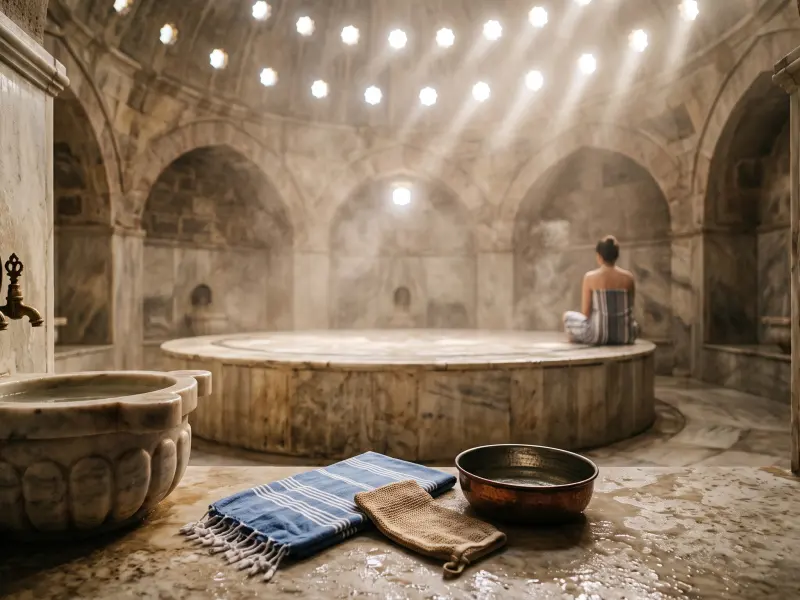
Why is the navel stone so hot?
The navel stone is heated from below — in traditional hammams, hot air from a furnace called the külhan passes through channels under the marble.
Its surface temperature is 40-50 °C. It may feel hot when you first lie down; spreading your peshtemal underneath you is a matter of both tradition and comfort.
The middle of the stone is hotter than the edges. If it gets too much, you can move towards the edge.
How long should you stay?
15-20 minutes in the hot room is enough. Staying longer brings no benefit.
Leave immediately if you notice any of these signs:
- Dizziness or light-headedness
- Palpitations
- Nausea
- Ringing in the ears
- Extreme weakness
These show that your body temperature has risen too far. Move to the warm room, sit down and drink some water.
Who is the heat risky for?
Heat has a marked effect on blood pressure. Consult your doctor if any of these apply:
- Cardiovascular disease and heart rhythm disorders
- Blood pressure problems — both high and low
- Diabetes (if you have neuropathy, your sense of heat is reduced)
- Epilepsy
- Pregnancy — a rise in body temperature is inadvisable during pregnancy, so the hammam is not recommended
Do not go in after drinking alcohol. Alcohol disrupts the body's temperature regulation and increases the risk of fainting.
For children
Keep children's time short and never leave them alone. Young children's body temperature rises faster. Many hammams apply an age limit; ask before you make an appointment.
Further reading
We have explained how a hammam works step by step. For how the time is divided up, see how long a hammam takes.
Venues offering a hammam: Turkish bath.
This article was written by the Spa Deneyimi editors. Rankings and verification badges cannot be bought.